What Buyers Check In Your Shopify Operation Before They Make An Offer In 2026
- Topic
- Small business
- Source
- Ecommerce Fastlane
- Published
This summary was written by ShopDigest AI from Ecommerce Fastlane’s report, by Steve Hutt. Read the full story ↗
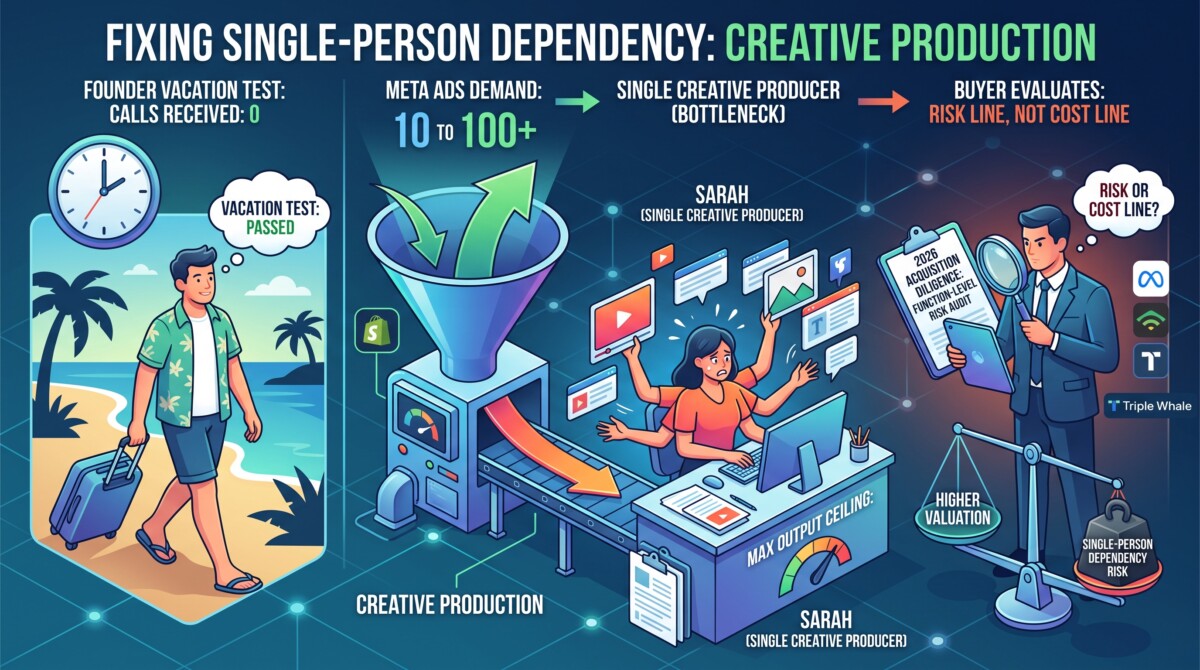
Buyers used to ask whether your Shopify business depends on you. In 2026 they also ask which individual functions depend on one person, because a marketing
Overview
This article explains how ecommerce buyers in 2026 evaluate Shopify businesses for acquisition, focusing on function-level dependencies rather than just founder dependency. It highlights that a business can pass the 'vacation test' but still have critical functions like creative production or email flows reliant on a single person, which buyers now price as risk. The piece offers a framework for founders to audit and fix these dependencies before seeking an exit.
Key Details
- Buyers now inspect individual functions for single-person dependency, not just overall founder reliance.
- A marketing operation running on one creative producer is considered a risk, not just a cost line.
- The 'vacation test' (go away for two weeks, count calls) is outdated; buyers double self-reported dependency numbers.
- Ecomma's Bawar Ahmad, with 72 acquisitions, focuses on 'agents' in place and the cost to build missing ones.
- At $4M revenue with nine people, each person holds a function outright, making dependency a valuation issue.
Why It Matters
For Shopify founders doing $2M to $10M annually, understanding and addressing function-level dependencies can significantly impact valuation. The article suggests that fixing the first dependency is feasible within a quarter without hiring, making it a practical step for those considering an exit in the next five years.